Wednesday, November 29, 2006

Mission and the Millennium Development Goals

The following piece is taken from my listserv, Toward2015, which can be joined through Listserv.Episcopalian.org


This is an attempt to respond to Tony Seel's question, "Would you like to comment on what it means for ECUSA to name the MDGs as our top mission priority? Personally, I thought that Jesus had given us our top mission priority in the Great Commission."


It is a question that requires much more time and thought that I have, but I will try my best.

For starters I want to say that the MDGs are generally a pretty good set of priorities when looking at the major challenges that face us in the world today. Most of them focus on areas that each of us, if we were to take them seriously, would be able to impact in some small way. For example, my wife and I have for a long time now sought to be as environmentally responsible as we can, because whatever we are doing to the environment we certainly aren't doing it a lot of good. I would encourage all Christians to try to see how the goals might help shape their own life and lifestyle as citizens of God's Kingdom.

Yet however valuable the MDGs might be they are not the Gospel of Jesus Christ, although taking them seriously might be part of our response as those transformed by the Gospel of Jesus Christ. One of the things that I have noticed time without number is that we have this fabulous ability of putting the cart before the horse -- which is what the Episcopal Church is doing on this issue, I think.

If you look back over the last several decades of the church's life each General Convention gets hot under the collar about something new and we play with that until the next Convention comes along, then drop it and go onto something new. In 1988, for example, it was the challenge of urban America, in 2000 we got anxious about evangelism and monkeyed with the whole 20/20 notion of doubling the church before 2020, then in 2003 it was sex, and now in 2006 in an attempt to take our minds off sex we are into the MDGs.

The truth is that the denomination functions a little like my 18-month-old granddaughter who has an attention span of about 45 seconds when it comes to toys, books, television programs, etc. The result is that the Episcopal Church seems to be on a permanent search for the illusive silver bullet rather than getting on with the serious business of being the People of God in a fallen world.

The rub is in the last sentence I wrote because the reality is that the tendency in most of the mainline traditions today is not to be sure that there is such a thing as a fallen world. This is where the theological rubber hits the road. If our understanding of the nature of God and the nature of God's creation is inadequate, then so will our response be. Certainly in the thirty years I have been a priest of this church few of the voices within the denominational structures have had what I would describe as a full-blooded Anglican theology shaped by commitment to the substance of Scripture and the values of the church catholic. The wind was sown and now we are reaping the whirlwind.
The truth is that what we believe is going to shape the ministry that we and the church have. During the last few days, in preparation for what we are going to be doing in our parish from Advent to Easter, I have been giving John Stott's The Cross of Christ a more careful reading than I have given it in the past. Both directly and indirectly John makes the point that what we believe about the Cross is going to give structure to how we minister within a needy world.

A huge proportion of the Episcopal Church, including many who claim renewal or biblical credentials, for my money do not take the Cross seriously enough as satisfaction for our sins -- partly because we do not believe that sin is as ghastly as it actually is. We do not take sin seriously enough because we do not have a clear enough grasp of the holiness of God and how impossibly wide is the gulf that needs to be bridged -- and is the reason for the death of Jesus, the God-Man.

I have in that last paragraph probably raised a huge number of hackles because if there is anything over which Episcopalians wriggle and feel uncomfortable it is that the Second Person of the Trinity voluntarily sacrificed himself, becoming sin that I might be freed from the bondage of sin (Galatians 3:10-14). This great and wonderful truth is considered offensive, and there have been occasions in the past when I have literally been shouted down asserting such a "primitive" notion although it is rooted and grounded in God's revelation.

Yet, primitive or otherwise, this notion is behind a wholehearted willingness to take into all the world the Good News of what Christ has done on our behalf. It is because Christ died as he did that we believe that no one comes to the Father except through him. That is a profound message and is one of the driving forces behind obedience to the Great Commission as presented in Matthew 28 and Acts 1. Jesus called us to be witnesses, and by every word and action we show forth whether or not the Cross is important to us, and what we believe about the Cross.

Now, it is because I am a person of the Cross that love for my fellow humans should be shown in the things that I do, like helping to promote universal primary education, helping to feed the hungry and ease the lot of the excessively poor, working to eradicate diseases like AIDS and malaria, and so forth. My wife and I actually in our own small way give time, treasure, or talent to all these areas, but we do it (and have done it for a long time) not because the Episcopal Church thinks it a great idea, or merely because all humans are made in God's image and should be honored and respected as such, but because the Son died for them and we want them to meet him just as we have.

In ECUSA it is my observation that there seems to be little real desire for those who are in need (physical, emotional, or spiritual) to meet Christ and have their lives transformed by him. Until I was excluded from life in the wider denomination in the latter part of 2001 I had been involved in National Church life in one way or another for a quarter century. I have to say that although in that time I met many wonderful people, few in those circles were comfortable with a forthright affirmation that Jesus Christ is Lord. Far be it from me to make judgments about their relationship with the Lord, but those relationship seldom bubbled over with the evangelistic enthusiasm that I have always discovered comes from finding out exactly who Jesus is and what he has done for me (and you).

When I served on the 20/20 Task Force there was often hovering in the background this notion that if we could find some technique or mechanism to enable evangelism to take place other than a forthright proclamation of the richness of the Gospel, then we would heartily embrace it. That inadequacy was there in the report that we produced, although its theology was richer than that. I suspect it was the richness of the theology and the audacity of the vision which means it has virtually disappeared from the agenda of the Episcopal Church as we have gone shooting off and redefined what it means to be male and female, and now fallen into the arms of the MDGs.

Quite honestly, regardless of which Anglican jurisdiction you happen to belong to, I have come to the conclusion that connexional structures do little or nothing to enable mission in the red-blooded biblical sense of the word -- indeed, most of the time they are a hindrance. Frankly, I do not expect the Episcopal Church as a denominational entity to have much of a clue what the Great Commission is all about.

The place where the Great Commission hits the ground is in congregations. God didn't call us to be dioceses or denominations, but to be local fellowships of Christian people called together by the Lord to go out into our Jerusalems, our Judeas, our Samarias, and then onward to the ends of the earth, proclaiming by word and action the Good News that is recorded for our guidance and edification in Scripture. When it comes down to it the local church is the basic unit of mission.

I had hoped a few years ago that ECUSA might be giving itself a chance to at least change the climate in the church regarding mission and evangelism, but it has rejected that course and instead has bought into the values and priorities of a fallen culture, and is thereby missing the point. I suppose in some ways this makes it less a church than a mission field into which some of us have been sent to proclaim the Good News that the Jesus who is Lord died in our stead upon the Cross that we might witness to the fulness of life that is ours through his love.

Saturday, November 25, 2006

The Future Means Mission, Mission, Mission, Mission

It is now nearly a month since we finally managed to elect a new bishop in Tennessee. The result is that for the first time in thirty-eight years of ministry I now look forward to being led pastorally by an ordinary who is younger than myself. Indeed, we go from having a bishop who is a great-grandfather to one who still has a kid in elementary school!

The other day I was in a business meeting with Bishop-Elect John Bauerschmidt, and laughingly he casually pointed out that at forty-seven and if the canons remain unchanged, he could be bishop for the next quarter century -- leaving office somewhere around 2030-2031. As one of the youngest potential members of the House of Bishops it is possible that he could have quite an impact on Anglicanism as it works out its future in North America.

This got me thinking about what things might look like if Dr. Bauerschmidt remains here, like his predecessor, until he reaches the maximum canonical age for retirement.

For starters, the world will be a very different kind of place, global warming or not. If present trends continue then the USA is likely to be the declining superpower while China could possibly be the rising superpower -- and with their huge populations, it is difficult to tell what sort of influence in human affairs China and India will wield.

And what will the Christian scene be like in China? Will their present growth in both numbers and influence mean that they will be in a position to shape the policies and strategies of their government and nation, or will they still be the harassed and sometimes persecuted body that they presently are? There are many Chinese Christians whose vision is to evangelize westward toward Jerusalem, and if this starts happening in some kind of significant way, what will it mean for relationships between China and the Islamic nations that sit in the Chinese Christian path?

By that time Islam will have changed as well? Whatever the state of Islam in its traditional heartland, it will certainly be an increasingly important player in Europe where the Muslim population continues to proliferate. I have seen statistics that suggest there will be more active Muslim worshipers in Britain by 2028 than there are Christians...

While all this is going on, what will be happening in North America, for these things are bound to influence the American churches? It is hard to say what the implications are, but the shallowness of much Christianity on this continent today does not auger well as the future comes to meet us. Whether we are talking the mainline churches and Roman Catholicism, or the conservative churches and evangelicalism, in too many quarters depth is strangely lacking. This suggests that as postmodernity and whatever comes after it charges ahead, there will be little in the way of a strong Judeo-Christian response to its self-centered, radically individualistic tendency toward destructive and unbridled hedonism.

Neither do Christian demographics look particularly encouraging for almost anyone, because as we move from older age groups to younger, a smaller and smaller proportion of each generation has any Christian involvement. In the Episcopal Church we might be worrying about the lack of youngsters, but quite a few others are not far behind us.

Which brings me back to the challenges facing the Bishop-Elect of Tennessee. The first, obviously, is to work out how to steer the diocese through the mess created by the actions of the last couple of General Conventions. Having stuck together more or less until now, we are beginning to see the first cracks. What is very clear is that the Diocese of Tennessee, as most other dioceses will not look anything like it does now by 2030-2031 if it still exists.

I suspect that during the next few years we will see just how unworkable in today's world geographical dioceses are. The future shape of dioceses is tied to fundamental questions that have yet to be answered about what exactly it means to be part of the Episcopal Church, whether the Episcopal Church is a constituent member of the Anglican Communion, and what the consequences at the grassroots all the way up the food chain will be if the Episcopal Church is not.

Besides, the Episcopal Church is going blithely on, totally ignoring the demographic realities that are rapidly catching up with it. It is an aging entity, and in many parts of the country seems incapable of adding new members by transfer, bringing in new converts to Christ, or where there are younger people increasing numbers by biological growth. Even without the defections that result from the actions of the General Conventions, this is a biggy that is being blatantly ignored despite statistics that scream out and plead for radical evangelistic and church growth action.

When I was on the 20/20 Task Force in 2000-2001, as we looked at the evidence in front of us it seemed that this attempt to create a mission-driven movement was the last great hope of the Episcopal Church of the USA. Our goal was to double the church by 2020. First, our proposals were pulled apart by the Executive Council, and then got lost beneath the sexuality agenda; right now ECUSA will be doing well if it has only shrunk in half by 2020. When the Episcopal Church effectively abandoned the 20/20 vision I realized even if it took a while, a huge question mark now hung over the future existence of this denomination.

I draw attention to this because if I was to be bishop of a diocese for the next twenty-five years in the midst of the present storm, I would concentrate every resource I had on mission, mission, mission -- and not and endless succession of social action projects, but working in every way to equip lay Christians to share their faith, to raise up young leaders who will work to guarantee a tomorrow, and to develop congregations with spiritual depth and theological integrity. If we did that the other stuff would follow.

Quite frankly, this is the only way any of us have any future. We can play church games but they don't bring people to faith in Christ and help them grow as pilgrims on the Christian way. Given what he is about to have thrust upon his plate, I do not envy our bishop-elect, although I pray for him every day. One thing I do envy, however, is that he has a quarter century in which he can make a difference for Jesus Christ, and a by-product of that will be the building up of a mission-driven and very different kind of diocese than the one he has inherited. If he does not do this, then he could have the sad task of being the one who puts the lights out.

Monday, November 20, 2006

Paranoia and Straws in the Wind

My whole Christian experience has been within the Anglican expression of evangelical conviction. Very early on I discovered that there is a paranoid streak among most flavors of evangelical, and I plead guilty for sometimes living into this characteristic that is often displayed by biblical Christians.

Sometimes, however, there has been good reason for evangelical paranoia, but often opposition has been either imagined or exaggerated. Meanwhile, it is not beyond the ability of evangelicals, like so many other orthodox Christians, to set themselves up for exclusion, harrassment, or worse, by their own inappropriate behaviors or attitudes.

Over the years I have increasingly been in the habit when I sense the urge to paranoia welling up within me, to try to get to the bottom of what is happening internally before blaming others for the problems I might be facing, or the difficulties into which I have fallen. When I do this I find that what might be happening to me has little to do with my affirmation of faith, and much more to do with the way in which I have handled myself. I sometimes think we like to believe we are being persecuted when in reality we are getting the just desserts for our own stupidity, bad manners, or the like.

Yet during the last several years there have been straws in the wind that unpleasant things are being done to orthodox believers that go beyond their own pugnaciousness or folly. There have been two in the last couple of days that point to the deepening reality that Christian orthodoxy is now so much on the outs in our secular culture and in the secularized churches that it is being seen as a threat to the postmodern world being born.

Now I know that it is not appropriate to argue from the specific to the general, but in many respects there seems to be a pattern developing. I suspect the two items to which I am about to draw attention are but the forerunners of many more, for our culture, as it drifts further from its Judeo-Christian moorings, is finding itself increasingly irritated by many of the stances and values of the revealed faith upon which Christian orthodoxy stands.

I became aware of the first of these at 5.00 a.m. yesterday (Sunday) morning when the clock radio clicked on and I lay there in the dark listening to a summary of the news. The last item of the bulletin drew attention to the plight of several Christian Unions in British universities.

The Christian Unions are hardly extremist organizations and have been part of the British university scene for generations. The UCCF is their umbrella organization, and they have incubated many lay and ordained Christian leaders, tons of them Anglicans. Both my wife and I came up through what was then known as the InterVarsity Fellowship, which was the setting in which we learned to think and live like Christians (http://www.uccf.org.uk) .

However, at Exeter, Edinburgh, Heriot-Watt, and Birmingham (where my daughter happens to be on the staff), the CUs have experienced various kinds of ostracism. In Edinburgh they have ceased to be a recognized organization of the university because they had the audacity to sponsor an event that promoted the traditional and biblical understanding of marriage and personal relationships, while in Exeter they have been banned from university facilities and had their Student Union bank account frozen.

Behind these attacks is an aggressive political correctness that in the name of tolerance refuses to tolerate what it believes to be the intolerant attitudes of these young Christians -- especially regarding human sexuality. "The 150-strong Christian Union in Birmingham was suspended this year after refusing to alter its constitution to allow non-Christians to address meetings and to amend its literature to include references to gays, lesbians, bisexuals and those of transgender sexuality." (http://www.christiantoday.com/article/christian.union.under.threat.students.prepare.for.legal.action/8379.htm). I find it hard to believe that the Trotsky or Islam Societies would themselves do what is expected of the CU.

While it is entirely likely that some of these Christian undergraduates in their youthful zeal for the Lord have become perhaps a little too strident, such a draconian response to their convictions, ideas that were the mainstream a couple of generations ago, has been harsh and a denial of their right of free speech, free assembly, and free expression.

It seems that if the secularizers had their own way they would drive orthodox believers to the very periphery of society, stripping them of their rights and privileges as citizens of a democracy, rights and privileges that find their roots in the very faith that they are marginalizing. Could it be that orthodox Christians will soon be considered as dangerous as Islamic extremists who fulminate violent acts of terror?

The other straw in the wind is much closer to home and comes in the form of a letter sent by Presiding Bishop Katharine Jefferts Schori to Bishop John-David Schofield of the Diocese of San Joaquin. This letter has all the delicacy and finesse of a velvet fist in an iron glove, with Schori, in effect, accusing Bishop Schofield of abandoning his ordination vows to defend the "doctrine, discipline, and worship of the Episcopal Church."

Here is a diocesan bishop, faithful to the rich mainstream of Anglican Christianity, and who is seeking to defend his diocese in the midst of the maelstrom which was unleashed upon the Episcopal Church by the actions of the 2003 General Convention, being threatened by a woman whose every pronouncement suggests she would theological be more comfortable in some variety of unitarianism. I recently broke bread with a colleague who is well to the left of myself, and he was shaking his head in disbelief over the lady's opening gambits.

Schori threatens Schofield with litigation, says that the people of his diocese will suffer, and suggests that the time has come for Schofield "to renounce your orders in this Church and seek a home elsewhere." What audacious arrogance! Katharine Schori does not seem to realize is that Bishop Schofield is actually being faithful to the vows he made when ordained to the priesthood, for like me he affirmed that he would “with all faithful diligence… banish and drive away all erroneous and strange doctrines contrary to God’s word.”

In the era Schofield and I were ordained, the 1979 Book of Common Prayer had yet to be dreamed up. He was ordained using the American 1928 Book and I was ordained using the English 1662 Prayer Book, each of which has some pretty far-reaching vows that priests are called upon to make to defend the church from error. Now error is, for the moment, ensconced in the heart of the church, and is is persecuting those who are faithful to revealed Christianity and the core of historic Anglicanism, so we are being utterly obedient to our vows by countering it.

This error that is imbedded in the church shares a lot with the aggressive secularism that is forcing orthodox believers to the peripheries of society, and might enjoy stripping us of many of our civil rights. There is little generosity and no grace in secularism's vision, and the same can be said for the vision of the faith held by the woman who the House of Bishop misguidedly elected at Presiding Bishop.

What should our response be? It certainly should not be to play the victim card, although I suspect that the politically correct, many of whom glory in their own 'victimhood,' would not allow us to do so. Nor should it be to return kind with kind -- besides, most of us have little power to do such a thing.

It is my conviction that we are being asked to stand at the foot of the Cross, being constant in our preaching and living, "in season and out of season" (2 Timothy 4:2). We are called to honor the Savior, and as we do so, in his own good time, he will honor us. This is only what Bonhoeffer would have described as the cost of discipleship.

To say that we stand beside the suffering church that has been and is being persecuted all around the world is to trivialize what our sisters and brothers are going through in Saudi Arabia, Iran, China, North Korea, and elsewhere. On the scale of their sufferings, we do not yet know what suffering and persecution is. However, could it be that the first steps have been taken down a path which will lead in this direction?

Thursday, November 09, 2006

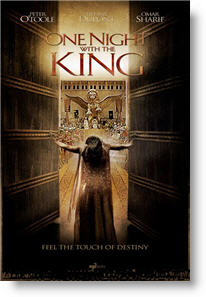
One Night With The King -- A Movie Review


"One Night With The King" -- Movie Review


A little while ago I wrote in my online Daily Devotions, while we were looking at the book of Esther, that this book would make a great movie. I had no idea that such a movie had been made and was soon to be released, something which one of the users of the devotions immediately told me.

Now in the theatres we went to see it a few days ago. I wish I could rave about the film and tell you that it is a must-see, but I cannot. There are bits and pieces of it that I appreciated, but in many respects it felt like a poor remake of an aging religious blockbuster like "The Ten Commandments" or "Ben-Hur."

Set in Susa, the capital of the Persian Empire, which is a place on the western edge of modern-day Iran, the city that the moviemakers conjured up using contemporary computer magic, was dominated by a palace that looked more like a merger between New York's Plaza Hotel and Niagara Falls! How much more meaningful it would have been if they could have put together something that was more period appropriate. The setting was more a tribute to the film-makers determination to exaggerate than to represent the beautiful story that tells itself so well in the Old Testament in the right scale.

The set from the very start had me on my guard: if they would take liberties with the environment of the story, then what was to prevent them taking liberties with the story itself?
In some ways they followed the basic drift of the book of Esther, but in other ways they embroidered in a manner that left me feeling antsy. For example, Esther is given a necklace that sparkles in a particular way to show us that she is of true Jewish heritage. Then one of her young male chums is hauled away and made a eunuch in the palace so that later he becomes a convenient go-between. Little touches like this might seem cute to a Hollywooder, but don't do a lot for someone who believes this is an extraordinary story that does not need such props in order to make its impact.

I imagine Esther to have been an extraordinary woman -- intelligent, charming, characterful. What we got instead was a delightful Esther, but one who would have been better cast as a member of the Susa High School cheerleading squad. Joyfully played by Tiffany Dupont, we got a more of a frothy (and sometimes thoughtful) middle American woman than the person of courage, depth, and integrity, who was prepared to put her all on the line in order to save her people from the wrath that Haman the Agagite was stirring up against them. I want to give Ms Dupont the benefit of the doubt and say that she didn't have much of a script to work with.
The story of Esther in the Bible is exquisite, one of the greatest tales of human literature as well as Holy Writ, but although it was not Disney that was behind this movie, there was a Disnification that softened the edges and missed the subtleties. (It is, in fact, distributed by 20th Century Fox). Perhaps it is dangerous when someone who has tried for much of his life to be a faithful Bible student to go to a representation of Scripture in a medium that works best when it trivializes.

Having said these unkind things about the movie, however, let me say some nice things, too. Although there is a lot of embroidery and some dumbing-down, "One Night with the King" does not stray too far from the original storyline. We get a watered down touch of the flavor of what Esther is about even if in the process we are robbed of the deeper dimensions.

For my money the star of the film was John Rhys-Davies, the Welsh actor who played Gimli in "The Lord of the Rings" and in this movie plays Mordecai, Esther's uncle and Haman's nemesis. Rhys-Davies captures the character who is there on the pages of Scripture perfectly. While I have already forgotten the Ahasuerus, the Esther, and the Haman, from the movie, as I scanned the Book of Esther this afternoon I was seeing in my mind's eye the face of Rhys-Davies's Mordecai, hearing his voice, and catching the twinkle in his eye.

I hope that now Esther has been presented in this rather inadequate way on the big screen someone else will pick the book up and do a far better job with it. It is a piece of biblical writing for times like these, when faithful people find their backs increasingly against the wall both in the wider culture and often, as for those of us who are Episcopalians, in the churches. It is a paeon of praise to the courage of ordinary people who are put in extraordinary positions at times when more than their own safety hangs in the balance.

Read the book... But if you do go and see the film, take a pinch or two of salt with you.

Monday, November 06, 2006

Sometimes The Runner Stumbles

During the last few days I have been enjoying Thomas Cahill's recent book, Mysteries of the Middle Ages, toward the end of which he focuses on Dante Alighieri and his most seminal of all poetry, The Divine Comedy. This poem begins with some of the most famous words in literature:

Midway upon the journey of our life
I found myself within a forest dark,
For the straightforward pathway had been lost.
Ah me! how hard a thing it is to say
What was this forest savage, rough, and stern,
Which in the very thought renews the fear.

So last night while driving home from a long Sunday I found myself comparing and contrasting the experience of Dante with that of Ted Haggard, one of the latest who midway through life's journey has found himself lost within that dark, dark forest. I ache for him to the point of tears, and for his whole family.

Until the last few days I knew little about Ted Haggard, except that he was President of the National Association of Evangelicals, pastored a big congregation in Colorado Springs, and had launched a significant prayer ministry. Now his dirtiest linen is being paraded for literally the whole world to see.

We might never know precisely what transpired between Haggard and his accuser, Mike Jones, and I have little curiosity to find out. Part of the tragedy is that everyone is involved when the sins and stumbling of a Christian leader are revealed in this kind of way. There are those who crow and point fingers, often stirred up by the feeding frenzy of highly inappropriate self-righteousness about the fallen one that comes with the revelation of yet another 'juicy' morsel.

The tragedy is that when someone with the profile of Haggard fails the Gospel is tarnished and the whole church, regardless of denomination and tradition, is hurt. The world shrugs and says, "Well, Catholics do it, Episcopalians do it, why should we expect Baptists, charismatics, or community church types to be any different," (if they are even aware of the panoply of names and titles beneath which we array ourselves). The next shrug to accompany their thoughts is about the veracity of the message we claim to live by.

I have no desire to castigate Ted Haggard. Virtually every one of us who has been called to Christian leadership is involved in a permanent wrestling match with their own dark side. Our problems may not be sex, drugs, or alcohol, but if we are honest we all battle inner demons that would delight to destroy us -- and the church. Most of us who have spent any time trying to live out this most demanding of vocations have dents in our fenders of which we are not proud, although we are thankful that in Christ we are forgiven, and by his grace we can be made whole.

Interestingly, few veteran pastors and Christian leaders are turning their fury against Haggard -- perhaps because they know their own fragility. Many of us watching the media circus probably whisper, "There but for the grace of God..."

All of us must recognize just how fragile we are, and that our lives are part of a spiritual battle being fought out in darkening times. We can expect both bad theology and ethical error to appear, sometimes in the lives of some of those who are seemingly the brightest and best. Isn't this the message Paul attempts to get across in the Pastoral Epistles?

I feel desperately sorry for Gayle Haggard. She began last week as the wife of a much respected pastor, and ended it with her life in tatters, probably discovering things about the man to whom she had been married that she either never imagined or tried not to repress. I pray there will be recovery but their life will never be the same again. As the Haggard family hunkers down to work their way through this avalanche that has buried their lives they need our support and prayers -- whatever it was that Ted Haggard did, or did not, do. This is what the grace of the Gospel is all about, and that same generosity should be extended to all pastors this day whose lives have come apart under the pressures of ministry.

It is clear something is amiss in Haggard's life and ministry, and we can only conjecture what it was. I suspect his undoubted success is less than helpful, together with the unquestioning devotion that often comes to pastors who have the richness of personality and ability that he clearly has. Accountability is vital for Christian leaders, something about which Prof. Ben Witherington has written in a telling manner: (http://benwitherington.blogspot.com/2006/11/looking-haggard-ted-steps-aside.html).

Witherington also writes also about the need to know ourselves, and especially the nature of our own Achilles' heels. Knowing our own fallenness and the damage it does to ourselves and those around us is an essential ingredient to spiritual and mental health as well as faithful ministry. In many ways peeling away the layers with which we try to protect ourselves from the darkness within is one of the most difficult and painful tasks for anyone entrusted by God and the church with leadership. Perversions of and diversions from the Gospel both individually and within the institution are likely to follow on from such failures.

The events of the last few days surrounding Haggard are a reminder to us above all us that if we are called to be healers in the name of Christ, then the wholeness we mediate can only take place when we are able to embrace our own brokenness -- and that in the power of the Cross. The Christian journey is a life spent allowing the balm of that Cross to penetrate ever more deeply into ever more corners of our life and being.

Sometimes The Runner Stumbles

During the last few days I have been enjoying Thomas Cahill's recent book, Mysteries of the Middle Ages, toward the end of which he focuses on Dante Alighieri and his most seminal of all poetry, The Divine Comedy. This poem begins with some of the most famous words in literature:

Midway upon the journey of our life I found myself within a forest dark, For the straightforward pathway had been lost. Ah me! how hard a thing it is to say What was this forest savage, rough, and stern, Which in the very thought renews the fear.

So last night while driving home from a long Sunday I found myself comparing and contrasting the experience of Dante with that of Ted Haggard, one of the latest who midway through life's journey has found himself lost within that dark, dark forest. I ache for him to the point of tears, and for his whole family.

Until the last few days I knew little about Ted Haggard, except that he was President of the National Association of Evangelicals, pastored a big congregation in Colorado Springs, and had launched a significant prayer ministry. Now his dirtiest linen is being paraded for literally the whole world to see.

We might never know precisely what transpired between Haggard and his accuser, Mike Jones, and I have little curiosity to find out. Part of the tragedy is that everyone is involved when the sins and stumbling of a Christian leader are revealed in this kind of way. There are those who crow and point fingers, often stirred up by the feeding frenzy of highly inappropriate self-righteousness about the fallen one that comes with the revelation of yet another 'juicy' morsel.

The tragedy is that when someone with the profile of Haggard fails the Gospel is tarnished and the whole church, regardless of denomination and tradition, is hurt. The world shrugs and says, "Well, Catholics do it, Episcopalians do it, why should we expect Baptists, charismatics, or community church types to be any different," (if they are even aware of the panoply of names and titles beneath which we array ourselves). The next shrug to accompany their thoughts is about the veracity of the message we claim to live by.

I have no desire to castigate Ted Haggard. Virtually every one of us who has been called to Christian leadership is involved in a permanent wrestling match with their own dark side. Our problems may not be sex, drugs, or alcohol, but if we are honest we all battle inner demons that would delight to destroy us -- and the church. Most of us who have spent any time trying to live out this most demanding of vocations have dents in our fenders of which we are not proud, although we are thankful that in Christ we are forgiven, and by his grace we can be made whole.

Interestingly, few veteran pastors and Christian leaders are turning their fury against Haggard -- perhaps because they know their own fragility. Many of us watching the media circus probably whisper, "There but for the grace of God..."

All of us must recognize just how fragile we are, and that our lives are part of a spiritual battle being fought out in darkening times. We can expect both bad theology and ethical error to appear, sometimes in the lives of some of those who are seemingly the brightest and best. Isn't this the message Paul attempts to get across in the Pastoral Epistles?

I feel desperately sorry for Gayle Haggard. She began last week as the wife of a much respected pastor, and ended it with her life in tatters, probably discovering things about the man to whom she had been married that she either never imagined or tried not to repress. I pray there will be recovery but their life will never be the same again. As the Haggard family hunkers down to work their way through this avalanche that has buried their lives they need our support and prayers -- whatever it was that Ted Haggard did, or did not, do. This is what the grace of the Gospel is all about, and that same generosity should be extended to all pastors this day whose lives have come apart under the pressures of ministry.

It is clear something is amiss in Haggard's life and ministry, and we can only conjecture what it was. I suspect his undoubted success is less than helpful, together with the unquestioning devotion that often comes to pastors who have the richness of personality and ability that he clearly has. Accountability is vital for Christian leaders, something about which Prof. Ben Witherington has written in a telling manner: (http://benwitherington.blogspot.com/2006/11/looking-haggard-ted-steps-aside.html).

Witherington also writes also about the need to know ourselves, and especially the nature of our own Achilles' heels. Knowing our own fallenness and the damage it does to ourselves and those around us is an essential ingredient to spiritual and mental health as well as faithful ministry. In many ways peeling away the layers with which we try to protect ourselves from the darkness within is one of the most difficult and painful tasks for anyone entrusted by God and the church with leadership. Perversions of and diversions from the Gospel both individually and within the institution are likely to follow on from such failures.

The events of the last few days surrounding Haggard are a reminder to us above all us that if we are called to be healers in the name of Christ, then the wholeness we mediate can only take place when we are able to embrace our own brokenness -- and that in the power of the Cross. The Christian journey is a life spent allowing the balm of that Cross to penetrate ever more deeply into ever more corners of our life and being.

Tuesday, October 31, 2006

Thoughts on electing a bishop

Bishop-Elect John Bauerschmidt

Over the last months all sorts of folks have asked why it has been so difficult for us to elect a new bishop in the Diocese of Tennessee. Now that the election is over, and Dr. John Bauerschmidt is Bishop-Elect, perhaps it is a good time to give some thought to this and related questions.

The first and most obvious answer is that we are one of the few dioceses that require at super-majority of 2/3 in each order for an election. This has sometimes been difficult to achieve at the best of times, but when the church is struggling to rethink itself in the wake of the actions of the August 2003 General Convention, this becomes progressively more difficult.

While we in Tennessee have been have been engaged in the battles that have riven the whole church, we aren't any more divided and polarized than most dioceses, indeed, I would suggest we might be in somewhat better shape than many. While people squirm in discomfort at either end of the spectrum, under the leadership of Bertram Herlong, despite the tensions, and seeking to be open to God's Spirit, we are remarkably together.I don't want to pretend more than the facts can stand, but in Tennessee there has been no terrorizing or punative use of canons, and even if one group predominates electorally there has been little if any misuse of power. Yes, tempers have been frayed and relationships are strained, which has been sad and difficult, but much of the reason for this has been that the equilibrium that existed prior to August 2003 was destroyed.

Furthermore, if in episcopal elections the Diocese of Tennessee had been a simple majority diocese like most others, then we would probably have elected at the first meeting of the diocesan convention last winter, and would have been moving ahead under fresh leadership by this point. As one friend from another diocese said of our super-majority system, "It is down right un-American!"

But much more than electoral politics has been playing itself out. This was a different kind of election because it involved a far more careful examination of theology and ideology. During my thirty years as a priest of this church I have watched with fascination and disbelief when in episcopal elections so few of what I would consider to be the vital questions have been asked of the candidates.

Many years ago I was asked to run in an episcopal election in a diocese with what I considered to be an exciting profile of what it wanted from its next bishop. Not surprisingly I didn't get very far, but I was far closer to what the diocese said it wanted than the successful candidate, but his charm offensive was unbeatable. The tragedy is that Episcopalians have generally been so untutored in the basics of the faith that they have tended to judge potential leaders in much the same way that they would elect the homecoming king or queen.

One of the few positives since 2003 has been that in Tennessee theology has moved higher up the pecking order. When someone is being elected to any office these days there are important theological questions that have to be asked, and these must not be sidestepped -- being nice is no longer enough. The truth is that during the last several generations mainline Christianity has turned itself into a theological wasteland, cut adrift from its roots in creedal Christianity and the catholic faith.

When I play a part by my vote of placing someone in any kind of office in the church these days I want to know about their relationship with Jesus Christ, and I want to know their convictions about the cardinal doctrines of the faith. I am concerned to know about their personal lives, and whether they match up to the standards for leadership that are outlined in the New Testament, and I am interested to know what they understand the mission of the church to be as well as the place and authority of the Scriptures.

I do not think we can be too demanding when selecting our leaders -- whether on the ecclesiastical or the secular playing field. I am certainly extraordinarily choosy about those seeking government office, and in one recent local election abstained in some races completely because none of the candidates seemed to measure up. If I expect much from those who represent me in the State Assembly and Congress, then surely I should expect much from those who lead me in the Body of Christ as Scripture proclaims?

We are very good at pointing the finger and laying blame. When looking at the mess that the Episcopal Church has become there is plenty of blame to go around, but seldom have those of us who seek to be obedient to the faith once delivered to the saints looked at ourselves and our own responsibility for this state of affairs, yet this is where we should begin.

Our failure has often been more a sin of omission than commission, for we have been sloppy about attending important gatherings and until it was too late have not been eager to run for elected office. When the biblical truth has been dragged through the dirt in church gatherings we have either remained silent or have defended it so badly that we have done more harm than good. We have put our own little corner of God's vineyard or our own segment of church life, before engagement in and with the whole church -- uncomfortable and unpalatable as activity in the wider church might be.

Would things have turned out differently if we had done some of these things? Yes, possibly, I think so. But whether things would have turned out differently or not is not the issue. We have been baptized, confirmed, and some of us ordained, as members of all the church, but we have not always wanted to engage with the whole church.

But now I have drifted a long way from my starting point. Today, October 31, is the last day in office for Bertram Nelson Herlong as Bishop of Tennessee, and tomorrow he transfers to the rolls of the Church Pension Fund after a long and faithful ministry. At the weekend we elected John C. Bauerschmidt to be the 11th Bishop of Tennessee. One era in our diocese has ended and another is about to begin. Already there are many of us prepared to gather around our new bishop and give him all the support that he needs and deserves if he is to lead us faithfully for a good chunk of the next quarter century. What we can be sure of is that when he retires from office North American Anglicanism will look profoundly different from what it is today.

Friday, October 27, 2006

Electile Dysfunction

During the last few months in Tennessee we have been treated to the political equivalent to mud-wrestling as the two candidates from the major parties have sparred neck-and-neck to win the vacant senate seat. My assessment is that one candidate has been marginally better than the other getting across to the public what he stands for, the other has been a master at getting across to us what he is against.

My heart sank when I saw my first negative ad in August and decided at that moment that as an increasingly independent voter unless the skies fell in I had little desire to vote for the candidate behind that ad. When his opponent began to respond in kind I knew that whatever happened I would probably go into the booth and press the button while metaphorically holding my nose. If we are to believe what each of these candidates says about the other then both of them belong either in prison or some gutter somewhere, which is reality is far from true.

While there is an intensity to this disgusting campaign in Tennessee that reflects what each side considers to be the issues at stake, it would appear that such tactics are now the norm in most corners of the political field. Shame on those who have drowned the noble task of seeking leadership in a foul-smelling ditch, why do we continue to encouraging them by listening to what they say?

Aggressive nasty-mindedness that we see in the realm of secular politics has invaded just about everything today, as had been predicted by many when the Boomers became the ones who set the agenda for our society -- yet the outcome is nothing of any value but rather nausea and gridlock. The same mentality that we see on the political field we see also playing out in the life of the church(es), with the varying sides allied less to the vision and values of the Kingdom of God and more to the policies and blindspots of the prevailing political biases in secular culture.

And talking of elections, tomorrow in the Diocese of Tennessee we attempt yet again to elect a new bishop. A friend the other day wondered which would come first the return of Christ or Tennessee choosing an ordinary! Another, inspired by those hideous medication commercials we are constantly treated to on television pointed out that the Diocese of Tennessee suffers from "electile dysfunction"....

While I think it more likely than not that we will come out of the election on October 28 with a bishop-elect, if I were a gambling man I certainly would not bet the house on it (and am of two minds about whether it would be a good thing or not, although I do not wish to continue in limbo).

Maybe I am getting cynical but it seems there is a touch of crap shoot about a bishop election, for you are not quite sure what is going to happen when the episcopate gathers around a lays hands on the bishop-elect. Sometimes they tear out his/her spine and addle the brain, but at other times (and less frequently) there seems to be an amazing screwing on of the head the right way.

While most of us in Tennessee are finding it difficult to get passionate one way or the other about the slate of candidates we have before us, I have been turning over the words of Admiral 'Bull" Halsey from the war in the Pacific in 1943: There are no great men, ony great challenges which ordinary men are called upon to face up to.

This is a time of great challenges and the stature of ourselves and our leaders is going to make itself plain in the manner in which we face up to and handle those challenges. I am praying today that the priest who ends up being Bishop of Tennessee will be someone who by his election to so fearful an office becomes great in the Kingdom through God's grace working in him, and as he seeks to address the challenges that are before us.

During this individual's episcopate I have no doubt that the whole of North American Anglicanism will reconfigure itself, and the Diocese of Tennessee will not be exempt from this rending and rebuilding among the ruins created by the failures of the last few years. What is clear is that there would be little or nothing left of the Diocese of Tennessee if the integrity of the Gospel is compromised.

In the early 1970s I came across words from John Stott to which I have returned many times since. They were written in his commentary on 2 Timothy entitled Guard the Gospel and are a warning to us all:

The devil hates the Gospel and uses all his strength and cunning to obstruct its progress, now by perverting it in the mouths of those who preach it, now by frightening them into silence through persecution or ridicule, now by persuading them to advance beyond it into some fancy novelty, now by making them so busy with defending the gospel that they have no time to preach it...

Monday, October 23, 2006

Post-Christianism

Early each morning I spend the best part of half an hour working out on my exercise bike watching television, jumping between the cable networks, BBC World news, and C-SPAN. This morning, as I was winding the session down I caught a few minutes of a conversation on C-SPAN with Mark Steyn, a columnist for the Chicago Sun-Times who seems to live a transatlantic existence, and about whom I knew very little until today.

I was about to turn the tube off when he was asked a question about politics in Europe and, focusing on Germany, came up with some perceptive thoughts which I have been turning over most of the morning. Before getting to it I have since discovered that Steyn is Jewish by background, Catholic by baptism, Anglican by confirmation, and presently attends a small country Baptist church.

Steyn was commenting on the development of post-Christian Europe, something the chattering classes applaud, and in passing observed that both the present Chancellor of Germany and her immediate predecessor were childless adults, suggesting that this reflected the now-ness and me-ness that prevails in Western European culture. He then went on to state that European culture in general is a great present tense culture that does not have the staying power beyond this generation.

I get the impression from his website that Mark Steyn rejoices in stating his case outrageously, but whatever his motives for speaking as he did, that thought is one that I cannot get out of my head. Having watched culture on both sides of the Atlantic now for more than thirty years he put into words something that I have been sensing for some time now, and that like the great statue in Nebuchadnezzar's dream that Daniel interpreted (Daniel 3:31-36), our whole western culture has feet that are mixed clay and seems destined to crumble in fairly short order.

There are plenty of signs that point in that direction, not least our utter self-absorption. Perhaps chosen childlessness is an example of this, as Steyn was suggesting when talking of the German chancellors: there has to be something unprecedented about a culture where a significant proportion of adults have problems with the notion that reproducing the next generation.

Then there is the ecological burden that we put upon the planet. Jared Diamond makes this case very strongly in his recent best-seller, Collapse, basing his findings upon the study he has made of various societies all around the world and across history. Diamond is not a pessimistic gloom-and-doom merchant trying to frighten us with ecobabble, but to use his words "a cautious optimist... (who has) decided to devote most of my career efforts at this stage of my life to convincing people that our problems have to be taken seriously and won't otherwise go away" (Page 521). Whether you like him or not, this is roughly what Al Gore is trying to tell us too.

Just as it is unwise to live beyond our financial means, so also is it foolish in the extreme to live beyond our ecological means and not being too worried about it. God made us to be stewards of his creation not its ravagers. But this tends to be a culture of immediacy, seeking satisfaction now and damning the consequences tomorrow. Would we have run up so much credit card debt if this did not have some truth in it?

I would further add that while our culture has arrogantly shown the Christian faith the door and effectively ushered it out into the cold, it has nothing substantial with which to replace it. Post-Christianism has appeared to have no real ideological base beyond me and the immediate moment, and its gospel seems to be one of consumption and hedonism -- 'gods' that are failing people left, right, and center because they are incapable of filling the all-too-real vacuum. Even the intellectual champions of post-Christianity seem incapable of cobbling together anything like a substantial case for their approach to life, and seem unwilling to do the hard brain work required to make one.

The other week I browsed Richard Dawkins' latest book, The God Delusion in Borders on the Bullring in the middle of Birmingham, England. Dawkins is a leading biologist and geneticist who has sometimes been labelled 'Darwin's Rottweiller' because of his commitment to evolutionary theory and aggressive agnosticism that for all practical purposes is atheistic. Brilliant in his field, he regularly strays into the realm of theology and philosophy where, quite frankly, he has not done his homework, yet he wants everyone to follow him.

His latest book (wonderfully reviewed in October 22nd's New York Times Book Review) is based upon the assumption that the notion of God is a pernicious delusion. As Jim Holt the author of the NY Times Book Review piece says, "The book fairly crackles with brio. Yet reading it can feel a little like watching a Michael Moore movie. There is lots of good, hard-hitting stuff about the imbecilities of religious fanatics and frauds of all stripes, but the tone is smug and sloppy." On top of this, which I picked up in my own brief browse of the book, was that he did not give any serious consideration to those who painstakingly and thoroughly developed cases that challenged his case and presuppositions, among them Stephen Jay Gould and Alister McGrath. Dawkins approach to debate has something of the flavor of John Shelby Spong about it.

I use Dawkins as an example because his is a loud voice that is part of the broad front attempting to put post-Christianism in place. It appears that most of the critics of the Judeo-Christian consensus which is being swept away have a knack for demolition work, but seem incapable of putting anything satisfactory or substantial in its place. Thus the vacuum remains and expands at the heart of our society.

The tragedy is that within the churches, where red-blooded Christianity does have a substantial response to post-Christianism, there are those who are touting their own post-Christianist flavor.

Leander Keck's The Church Confident was published more than a dozen years ago but much that he wrote still rings true. The former Dean of Yale Divinity School writes that in the mainline churches substantial faith and theology have given way to the bizarre and the banal, with the result that we suffer from "theological anorexia." "The mainline churches have inherited theological wealth sufficient to serve substantial theological fare, but all too often they offer little more than potato skins to those who hunger for a real meal" (Page 46). I certainly see this is so much of our Episcopal futility.

Yet the task of the Christian church is to witness into post-Christianism to something far better and richer, but that seldom seems to be happening. Not only is it the mainline churches that are caught up in their own kind of post-Christian cul-de-sac, but so also are many of the conservative churches, baptizing the American dream rather than challenging it to conform to the great doctrines and values of Scripture.

In this environment then, it seems that the life expectancy of our culture has to be short. Without an ideological base, living beyond it means in every way, and focused almost exclusively on the fulfilment of the self, it is already like a barque that is holed and leaking, it is only a matter of time before it capsizes and goes under. The question then is what will take its place, and where will the churches be? I suspect that before then, however, we could very well see the wholesale (and sophisticated) persecution of the congregations and individual Christians who stand up to post-Christianism, and it could be from this that the solution to the conundrum comes.

Friday, October 13, 2006

"Being A Priest Today" -- A Book Review

Being A Priest Today - Christopher Cocksworth, Rosalind Brown (Norwich, England: 2002, New Ed. 2006. Canterbury Press)

A Book Review

For the last thirty years or so I have been listening to all sorts of explanations and arguments about the priesthood, most of which have seemed minimalist or sometimes just plain wrong. During this period my own understanding of the vocation in which I have spent virtually my entire adult life has developed and matured, usually in fits and starts, and it is in this process of what I hope is healthy growing that I have become ever more uncomfortable about the claims and notions that I hear.

What is refreshing about Being A Priest Today, is that the authors, a man and a woman, both priests and theological educators in the Church of England, is that it starts out with an ontological understanding of the nature of the presbyterial role rather than dealing with function or status. It begins with the God who has called the whole church into its priestly witness with the wider world God has made, a task within which the order of priests plays a particular part, although to quote Rowan Williams "there is no one way of being a priest" (Page 4).

Too much of what I have read and heard about the ordained has either focused on the functions of leadership and the how-to of undertaking them, or it has majored on sociological variables like rights, and whether this particular group is represented within the rolls of the ordained in the life of the church. I have been on a Commission On Ministry and year after year have listened to people implying that because they are who they are they have some kind of right to be ordained, rather than approaching this task with the utmost fear and trembling.

In true postmodern style the priesthood is so often seen as a place of power, and therefore it is vital that "we" (whoever "we" happen to be) have a seat at the table in the palaces of power. To think of the priesthood in this way is sheer bunkem. Cocksworth and Brown do not even bother to address these misperceptions of what priesthood is. This is not a contentious, argumentative work, rather these two set out with gentleness, clarity, and precision to present a far fuller and richer picture of this task to which some of us have been drawn by God, drawing upon Scripture and the richness of the Christian tradition. "Our calling into Christ is simultaneously a calling into Christ's messianic ministry, his service" (Page 5).

Being A Priest Today is a book that needs to be read with care, it is not something you can rattle through in an hour or two, and it is even dangerous trying to scan passages that look less significant because you can be sure that you will miss some of the treasures that lie buried deep within what is being said. Certainly, anyone who cherishes the misconception that priesthood is about power will have been forced to surrender such an idea by the end of the opening chapter. If you fail to do this, then you miss the point of the book in its entirety.

The authors tell us, "There is only one Christian priesthood, and that is the priesthood of Christ, the priest into whose ministry we are gathered through baptism and by faith, and in whose life human identity is perfected," (Page 9)and this priesthood is focused on the perfect sacrifice Christ has made for us, and just as he is one whose life was lived entirely for others, so is that the reality with the ordained who are presbyters in the priestly community.

The opening chapter, which is the key to all that follows, revolves around a masterly unpacking of Paul's charge to the leaders of the church in Ephesus in Acts 20. As I went through this exposition I circled the words about priestly ministry that seemed the most significant: "teaching... protecting... faithful evangelistic preaching... catechetical teaching... care of the Church... the towel a symbol of authority... tears... the mantle of suffering" (Pages 12-13).
If the Body of Christ has been called into being by the Holy Spirit, priests are to function as men and women radically dependent upon the workings of that same Spirit. It is not only an office that shapes the church's life by what it says and how it instructs, but it is one that is called by that self-same Spirit into a life of prayer and of holiness "that will be an example to the Church" (Page 21).

Today such holiness sounds a radical (almost innovative) idea, but not only do Cocksworth and Brown back it up from 1 Peter 5 and Acts 20, but also from the charge to the presbyter in the 2nd Century Canons of Hippolytus, but also from the bishop's charge in the contemporary Roman rite for ordination of priests. It is this call to holiness that, as far as I can see, is then filled out in the remainder of the book, beginning with the fact that the priesthood is a call to being for the Other and being for God.

The priesthood is about being for worship, the Word, and prayer. It is about living holy lives, being agents of reconciliation, and as men and women of blessing. Each of these chapters is chock full of substance and challenge, and my copy of the book that I read on both sides of the Atlantic as well as in a 767 over it, is as marked up with underlinings and marginal notes as any book that I possess.

There are sweet quotes like, "Our vocation is to combine a passion for God's living word with a joy in living in God's world" (Page 84), or "Polishing and perfecting the saints, ourselves included, is a lifelong vocation to holiness" (Page 153).

Living in the midst of the angst that is the Episcopal Church, and watching beloved brothers and sisters tearing apart, and tearing one another apart, I found myself particularly challenged by the chapter "Being for Reconciliation." God, we are told, would stop at nothing to reconcile us to himself, and we as those who preside at the Eucharist, the rite, as it were, of reconciliation, have a special responsibility for this ministry both in the church and beyond.

If our task is to minister to those seeking reconciliation to God, hearing confessions and pronouncing absolutions, then this has profound implications for the way we as clergy live our lives amidst so much division and bitterness. The church should be the body which, by its own determination to be reconciled with one another, shows forth what God's purpose is for all people -- yet how far we are from that reality. "The tendrils of reconciliation run widely and intricately throughout God's world, the tap root is the reconciliation of God in Christ who is our peace. We who are reconciled to God ourselves are entrusted with the ministry of reconciliation" (Page 179).

Yet the reconciliating power of the Gospel is not some lowest common denominator kind of thing, sentimental mushiness, or brushing differences under the rug that is so often presented as reconciliation, rather it is something that cannot and does not contrive to sidestep the Cross, God's supreme reconcilatory act. Reconciliation is painful for all involved, including the reconciler.

The truth is, and this bubbled through this whole book, there is a tremendous amount of suffering and pain that are part and parcel of the priesthood -- because the Christ we follow is one whose life was shaped by suffering and pain. And so it is that we our sent out in mission -- which is the burden of the final chapter of the book.

Drs. Cocksworth and Brown use a plenitude of resources to make their case from the Apostolic Fathers, Henri Nouwen, and Dallas Willard to liturgical rites from around the world and a richness of traditions. They quote John Donne, George Herbert, Michael Ramsey, Richard Baxter, and John of the Cross, as well as John Wimber, Oswald Chambers, Eugene Peterson, Julian of Norwich, and Barbara Brown Taylor. The text is enriched by the delightful poems and hymns of Rosalind Brown. This is not a book with a party flavor or a narrow bias, and neither is it one that is for the faint-hearted.

If you are a priest and you read this book, be ready for your presuppositions and practice of your vocation to be changed, as well as any sense of satisfaction that you might have with your own sanctification. If you are a layperson reading this book, then not only will it raise the bar for your own discipleship, but it will help you to challenge (graciously, I hope) your own clergy in the exercise of their ministry among you.

Friday, October 06, 2006

Seminaries in a Post-Christian Landscape

I have spent the last few days in England, and have been hanging around one of the theological colleges of the Church of England. It has been good to interact with the students and faculty, I have enjoyed the liveliness of the worship in the chapel, and the sense of mission that so many of the people have here.

Britain is far from an easy setting in which to do ministry, so it is encouraging to see so many gifted men and women who are willing to offer their all in the service of Christ, who gave his all for them. What has struck me about this place is a determined integration of right believing with right practice, and of scholarship that is rooted in a Kingdom-driven approach to ministry.

I was chatting the other morning with the principal, somehow we got onto the subject of monastic models and I found myself talking about Thomas Cahill's marvelous book, How The Irish Saved Civilization, that made such a splash in the USA a few years back. The thesis of the book, if you remember, is that when the Roman Empire collapsed Ireland became the refuge for Christian learning, many of the treasures of the ancient world finding their way into the various monasteries that existed there.

After a century or so, as the worst of the "dark ages" began to ameliorate themselves, it was monks who spread out from the Emerald Isle and took back to Europe with them both learning and the gospel of Jesus Christ. Many of the great monastic foundations that became beacons of hope and centers of learning throughout the northern part of Europe can trace their origins either directly or indirectly to Irish missionary monks.

How The Irish Saved Civilization is not a book that made it in the UK as it did in the USA (Surprise, surprise), but as I outlined its theme the principal's face lit up and he said something like, "Wow, the theological college model we have pursued for so long is one that is broadly Benedictine, but a Celtic model makes a great deal more sense for this day and age, with the seminary being the base from which mission is undertaken as people go out from there into the hostile culture around them."

I thoroughly agree with him. I believe that in some ways we are entering a different kind of "dark age," and that in the economy of God there is a need for places that will stand firm, remain faithful, preserve the deposit of the faith, and then communicate by word and deed the message of salvation to those around them. Could it be, I wonder, that the seminaries could be the Celtic monasteries of this age?

Yet it is obvious that not all our seminaries are doing the job in the way that they should, whether you measure them against a Celtic or a Benedictine model. The majority of the seminaries of the Episcopal Church are a very mixed bag, many having either modified or seemingly turned their backs on the undergirding essence of the deposit of the faith. The question is whether they are able to be these beacons of hope that are required. Given the performance of the leadership of ECUSA in the last few years I have to suggest that most of them are the reverse.

That reminded me of an illustration used many years ago by Richard Lovelace, a Presbyterian, and then Professor of Church History at Gordon Conwell Theological Seminary. In one of his books, where he was talking about spiritual renewal, he likened a seminary to a garden sprinkler. As the sprinkler swivels around and around the water that gets sprayed over lawn or garden brings rich greenery and colorful life. However, it only takes a few drops of acid to get into the mix and an entirely different result is the outcome.

Lovelace commented that while some seminaries have a spiritual dynamic that is like water being sprayed out from the sprinkler, enriching the lives of the churches around them, there are some seminaries who produce acidic water that will ultimately destroy all those who, as it were, nestle in their shade.

As I look at the woes of the church to which I belong I cannot but confess that the seminaries have played a huge part in our demise. Acid rather than the bracing fresh water of the Gospel has been their product. So, if we are moving into a dark age, then whatever strategies we puruse, it behooves us to do something significant about seminaries so that they might be centers from which mission, ministry, and "civilization" go forth.

Saturday, September 30, 2006

Lee and Minns

There are still a few more mows of the lawn that need to be done before the grass stops growing here in Middle Tennessee, and I was out there doing one of those mows this afternoon. As I did so I mulled over the news that Bishop Peter Lee of Virginia has licensed Bishop Martyn Minns of Truro Church and the Convocation of Anglicans in North America, which is part of the Church in Nigeria and primarily provides covering for Nigerian and some other African Anglican congregations.

I have seen all sorts of comments that this would not have happened, etc., if Martyn had not been Rector of a large and wealthy parish, which may be true, but it seems to me that there is something positive about this to be rejoiced over. To me, it is a little crumb of comfort.

Those who led the Episcopal Church into the chaos in which we find ourselves by their actions in August 2003 seemed to come away from that Convention and the resulting furor with the notion that things would settle down, everyone would get used to the idea, and so on. This demonstrates how detached from reality their minds were. Like so many postmoderns they refused to recognize that idea and actions have consequences -- and that there would be a huge fallout from such actions.

What those who perpetrated these acts seemed to think was that even if they continued a process of radically changing the substantive doctrines of the denomination, while the structures would remain unchanged and the funds would continue to flow in. That obviously is not the case -- as I said in the previous paragraph, actions and ideas have consequences, and one of them is the eventual radical reordering of Anglicanism in the United States, a process that has already begun.

Thus, while championing notions that are far from God's self-revelation, those on the left continue to cherish the bizarre notion that the old-fashioned geographical diocese is going to remain untouched. Not only is this not the case, but the Lambeth-Chicago Quadrilateral allows for alternative approaches to the shaping of the historic episcopate as an appropriate means of oversight and catholic continuity.

Although it is hard to see what will take the place of the present structures at this point something will. It is also hard to see how the ECUSA dioceses will related to the elements of Anglicanism in North America that are part of the Communion, but not part of ECUSA -- like Minns' CANA.

What encourages me about this willingness of Bishop Lee to license Bishop Minns is that this is a tiny baby step of recognition that we cannot go back to the status quo ante August 2003, and that new relationships and approaches to being in connection with one another (or out of connection with one another) will have to take the old structure's place. At least Peter Lee is looking for an orderly way ahead in finding linkages, which is more than can be said for some of his fellows in the House of Bishops -- and their more vocal supporters.

Tuesday, September 26, 2006

A Sad Day In Rochester, NY

In the last few days I learned that All Saints' Anglican Church, in the leafy Rochester, NY, suburb of Irondequoit was taken back into possession by the Episcopal Diocese of Rochester under court order. I was the Rector of All Saints' Church from the late seventies until early 1985, and although the years we spent in Rochester were very difficult for our family, I feel grieved for the people of that congregation -- some of whom were parishioners when I served there.

While I am not sure that the congregation behaved wisely in its approach toward the Diocese of Rochester following the unfaithful actions of the General Convention in August 2003, neither do I think the Bishop of Rochester and his supporters have shown the smallest shread of grace and generosity toward the parish. Last November they removed All Saints' from the diocese by declaring All Saints' extinct, using a diocesan canon whose intention was entirely different from the purpose to which it was put. This kind of canonical gerrymandering is the kind of disingenuousness that is designed to further alienate.

Since last year I have often found myself thinking about the old long-time members of All Saints' that I remember during my years there, some of whom were charter members of the parish, and who spent their whole lives as members of the congregation. I buried the last founders of the parish while I was there. All of them would be appalled at what the Diocese of Rochester has become as a well-endowed pioneer of an agenda that not only deconstructs the Gospel, but is profoundly damaging Anglican Christianity both at home and around the world.

I am sure that the Bishop of Rochester and his chums are as pleased as punch that they have taken the building, but I suspect they will not only be incapable of replanting All Saints' Episcopal Church because 'progressive' Christianity has very limited abilities at reproducing itself, but that in a relatively short period of time "For Sale" signs will appear on the church lawn and those funds will be dropped into the already bloated coffers of the Diocese of Rochester.

Much of Upstate New York is very much a spiritual burned over district for biblical Christianity in any shape or form, and has been for many years. The years I spent there were among the hardest in my life, and I am in touch with pastors of various denominational traditions from my time in Rochester, but now elsewhere, who look back on those years for themselves in their own traditions as some of the most difficult. I suspect that today it is virtually impossible for an orthodox ordained person to play any part in the Diocese of Rochester, and I suspect that the statistics demonstrate the Episcopal diocese is seeing the same kind of decline in membership that we were seeing when I was there more than twenty years ago.

Friday, September 15, 2006

Pope Benedict XVI and Islam

The Islamic world is once again in uproar, this time at the Pope. On Tuesday, September 12, Benedict XVI returned to the University of Regensburg, Germany, where he had once been a member of the faculty, and there he addressed a gathered audience, presenting a paper that dealt with the relationship between faith and reason, with some personal reminiscences thrown in.

Today, Friday, the Muslim day of prayer, there are protests and renunciations all over the Islamic world, accusing the Pope of dishonoring their faith. In places like Egypt and India there are street protests with the burning of effigies of the Catholic pontiff, while in Pakistan troops are guarding Roman Catholic churches. The Palestinian Prime Minister said, "In the name of our Palestinian people... we express our condemnation of the statements of his Excellency the Pope, against Islam as a belief, sharia, history, and a lifestyle."

What on earth is it that so careful a man as BXVI has done to merit such an outcry? Well, he seems to have used a rather unfortunate illustration in the context of a closely argued and philosphical speech so that the whole weight of what he said has been lost under the welter of fury. I spent some time this morning reading Benedict's paper and I have to say to the Palestinian leader and others of his ilk, "Come on, guys, read with care the words the man said, not what you think he said."

In 1391, probably somewhere close to modern Ankara, Turkey, the erudite Byzantine emperor, Manuel II Paleologus, was involved in a dialogue with a Persian academic about Christianity, Islam, and the truth of them both. In the debate the emperor said that there should be no compulsion in religion, for compulsion tended to compromise the rationality of faith, and in the midst of these long conversations he questions the tendency of Islam to violence, describes this as unreasonable, and "incompatible with the nature of God and the nature of the soul."

In the midst of the cut and thrust of debate around this topic the emperor is reputed to have said, "Show me just what Muhammad brought that was new, and there you will find things only evil and inhuman, such as his command to spread by the sword the faith he preached." Benedict quotes this. At this point it needs to be remembered that this man grew up in the midst of the violence that once was Germany, which helps put his own detestation of violence into perspective.

He then goes on in his paper to talk about the Christian faith and its rootedness in reason, with the suggestion that because for the Muslim God is "absolutely transcendent... his will is not bound up with any of our categories, even that of rationality." He continues closely arguing his case, drawing on the Reformation, liberal theology of the 19th Century, and 21st Century pluralism by way of further example and illustration. It is a tightly argued case, too, and I suspect that for many of the media who might have been present, the Muhammad illustration could have been one of the few parts that they thought they understood!

There is nothing in this paper that gives the slightest suggestion that Benedict shares the mindset of Emperor Manuel II Paleologus, merely that he is philosphically presenting the rationality of God, and this he thought was a good springboard into the point he is making. Yet now there are tens of thousands of people, egged on by certain leaders, very few of whom will have read (or understood) the Pope's argument, condemning him for his hatred of Islam.

The trouble is that there is nothing in the paper or in much of the conduct of Benedict XVI toward Islam which suggests hatred. If by their fruits you shall know them he has been working hard to understand Islam - which seems to have been undone by a mixture of inadequate (perhaps irresponsible) reporting of the Pope's remarks and their context, as well as the hot-headedness eagerness in certain corners of Islam to condemn what they thought might have been said.

Was the Pope wise in his choice of illustration? Even popes have occasional lapses of wisdom, and I suspect he could have given this a little more thought; but he was probably naive enough to believe that what he said would not be as badly misrepresented in the media as it is. I have garnered most of my information from the BBC Website (http://www.bbc.co.uk/), and think that they have been less than helpful in the extracts of the paper that they have published when put alongside the full text(http://news.bbc.co.uk/2/shared/bsp/hi/pdfs/15_09_06_pope.pdf)- this is text out of context stuff.

I wonder how many members of Pakistan's parliament had even looked at what he was saying before passing a resolution which contained the following renunciation, "The derogatory remarks of the Pope about the philosophy of jihad and Prophet Muhammad have injured sentiments across the Muslim world and pose the danger of spreading acrimony among the religions."

I do not see that the Pope has anything to apologize for, although he is probably rather sore that something said (he thought) in all innocence has been blown up out of all proportion and damaged bridges he thought he was building. All this demonstrate that when it comes down to it, there are large swathes of people in the Islamic world who are determined to misunderstand, and have elevated their Prophet to a level that is above study, analysis and contradiction. This can hardly be said to be rational behavior -- but then the same thing goes on in the West, too.

Toward the end of his paper the Pope says of ourselves that, "The West has long been endangered by this aversion to the questions which underlie its rationality, and can only suffer great harm thereby. The courage to engage the whole breadth of reason, and not the denial of its grandeur -- this is the program with which a theology grounded in Biblical faith enters into the debates of our time."

He concludes by saying, "'Not to act reasonably, not to act with logos, is contrary to the nature of God,' said Manuel II, according to his Christian understanding of God, in response to his Persian interlocutor. It is to this great logos, to this breadth of reason, that we invate partners in the dialogue of cultures..."

My response to that comes from the culture of Southern religion, "Preach it, Brother Benedict, preach it!"

Saturday, September 09, 2006

"Jesus, The Bible, and Homosexuality" by Jack Rogers -- A Book Review

Jesus, the Bible, and Homosexuality by Jack Rogers (Louisville:Westminster-John Knox, 2006, 126 pages, plus endnotes)

A Review by Richard Kew

I no longer take the Episcopal News Service very seriously, but the other week as they touted Jack Rogers' book, Jesus, the Bible, and Homosexuality, I decided I ought to read it. Intellectual honesty demands that we take serious the viewpoints of those with whom we disagree with a view to, perhaps, changing our minds. Besides, it was high time I took another look at what is being said by those whose take on human sexuality is different from my own.

Jesus, the Bible, and Homosexuality promised to be interesting because it is not often that a former professor of an evangelical seminary gets endorsements from Gene Robinson and the Moderator of the Metropolitan Community Church! (Rogers taught at both Fuller Seminary and San Francisco Theological Seminary). Jack Rogers has been a leader in the Presbyterian Church (USA)for many years, and was at one point Moderator. He has a sterling evangelical pedigree, but has been in trouble in the past for thinking outside the box. I expected to be challenged, and I was.

I spent the Labor Day weekend grappling with Rogers, learning much and asking fundamental questions of myself and my beliefs. Unlike so much that I have read on the permitting side of the sexuality issue, Rogers seriously attempts ground all that he says in a scholarly use of the Scriptures and a biblical worldview.

Because the book maintains a relatively eirenic tone, there were parts I thoroughly enjoyed, and especially good is his chapter on interpreting the Bible during controversial times. This, coupled with the insights that he give into the development of theology over the past couple of centuries, makes the book of value regardless of the debate over sexuality in which we are all involved. While Rogers' jumping off point is the historic and confessional documents of Presbyterianism, there are many points of contact with mainstream Anglicanism. Yet the book is doggedly Americo-centric and makes absolutely no reference to the wider church in both space and history.

Rogers rightly complains that conservatives are often selective in the way they use information and Scripture, and this is something that needs to be address with great seriousness. But the finger also points back at Rogers because he uses his own flavor of selectivenes as he attempts to promote the theology and agenda to which he now adheres. Perhaps given the emotive nature of this presenting issue, it is impossible for anyone to come at it without seeming to grind their own axe.

But let me get to the substance of the book. Jesus, the Bible, and Homosexuality is partly Dr. Rogers story of his own journey from the exclusion to the inclusion side of the equation when it comes to the role of openly homosexual people in the life of the church. He uses what I would describe as his own eccentric doctrine of theological development to give legitimacy to his arguments.

In summarizing he writes, "The best methods of interpretation, from the Reformation on down through today, call upon us to interpret the Scripture through the lens of Jesus Christ's life and ministry" (Page 126). The case he makes is an attempt to demonstrate that it is not an unreasonable leap from that starting point to the point where we accept that "using this method, we see clearly that Jesus and the Bible, properly understood, do not condemn people who are homosexual. In church governance, our confessions and the Book of Order embody a trajectory of ever-greater inclusiveness. To bar gay and lesbian people from ordination and marriage is a violation of those fundamental principles of our faith" (Page 126).

It is Rogers' thesis that as we look back over the history of the Christian faith during the last couple of hundred years, we see a process of theological modification going on that has increasingly opened the doors to minorities and the excluded. He demonstrates that not long ago the churches in the United States not only accepted slavery and racial segretation, but attempted to justify it from the Scriptures. More recently the same can is true of the role and place of women in the church and society.

If, he argues, we did the right thing modifying our theology to correct these injustices, then should we not now apply the same principles when it comes to another excluded group -- those who are defined and who would define themselves as homosexual?

He points out that Christians have, in order to be pastoral, modified their application of what Scripture teaches about marriage and remarriage, so why cling to old prejudices regarding those who are of a homosexual orientation and wish to live in a faithful relationship with a lifelong partner? He believes this entirely appropriate and writes, "Jesus did not set forth immutable laws to break people. Rather, he set forth an ideal toward which we all should strive -- lifelong faithfulness in married relationships. That ideal could apply to gay or lesbian couples as well as to heterosexual couples" (Page 44).

There is little doubt that doctrine develops, and also that since the beginning each generation (or sub-grouping) has fallen into the temptation of reading the bible through its own culturally-conditioned set of presuppositions and prejudices. This means that there is a steady development of Christian doctrine, as by a trial and error approach we sift what God is saying within the context of changing circumstances, then making course corrections on that basis. The truth is that it sometimes takes centuries to get things right, while at the same time shaped by the cultures in which we live we ourselves read fresh errors and misperceptions into the text.

Neither does doctrinal development proceed in anything approaching a straight line evolution in one direction or another, as Jack Rogers would like us to believe. Ideas and theology develop within the context of a culture, being shaped by it, but also they seem to move forward in a particular direction, then they back up, then they begin to identify nuances or partial mistakes that need to be taken into account, and so forth. For example, the modernists who seemed to be carrying all before them in the early part of the 20th Century on both sides of the Atlantic would have laughed you to scorn if you had said in the latter part of that century their ideas would wane and give way to an evangelical resurgence of both numbers and academic theology.

So enamored is Rogers by his theory of development that he is unwilling to critique the manner in which the culture shapes the Christian churches, demanding that they conform to this image. He seems to assume that the radical individualism and emerging sexuality of our times do not require justification when measured against Scripture (however it is handled), and the development of doctrine in the church.

There is, for example, an uncritical acceptance of the American Psychiatric Association and the American Psychological Association's consideration that homosexuality bears none of the marks of a disorder. The only take that he has in opposition to the APAs is that of Dr. James Dobson, which is hardly representative of a larger swathe of discomfort with these particular decisions. While the APAs may reflect a certain segment of their professions at this moment, there is no reason to believe those in these professions who disagree with the professional organizations' stance will always be on the outs as research continues and new ideas emerge.

Neither do I find Rogers' handling of the biblical materials concerning homosexuality convincing. Firstly, he merely deals with a handful of "purple passages" that either address, or are purported to address homosexuality, and secondly, he tends to dismiss strong cases that are made from an intense study of the Scriptures on a very flimsey basis.

A clear example of this is that early in the book he questions Scottish Common Sense philosophy that he rightly believes shaped American thinking and theology from the 18th Century onward. When he gets to addressing what Scripture teaches he dismisses Robert Gagnon's extraordinary thorough critique of the Scriptural text, The Bible and Homosexual Pracice, as "a classic example of the misuse of natural law in theology" (Page 81). Those from St. Augustine to Karl Barth knew little of Scottish Common Sense philosophy...

It is here, I find, that Rogers flies in the face of his stated principle that Scripture should be read as a whole without individualized proof-texting. He quotes Richard Hays as saying, "The Bible hardly ever discusses homosexual behavior" (Page 69), but from the outset Scripture presents male and female as complimentary genders to one another, together reflecting the image of the God who reveals himself.

Maybe contemporary perceptions of what it means to be homosexual are somewhat different than those of biblical times, as Rogers makes clear, but present perceptions do not justify a radical decontruction of sexual morality as found in Scripture. Furthermore, while Scripture as a whole raises significant questions about the morality of slavery, segregation, and the subordination of women, it is extremely difficult to say the same of homosexuality within the wider context of biblical morality as understood by the church catholic and historic Judaism.

When I was at high school I regularly receive back papers I had written which had emblazoned along the top in red ink the words "Good Effort," then when you looked at the grade put beside these words it was less than stellar! I would say the same of Rogers' book. It is a good effort, a nice try, but he needs to do a lot more with it if the case he makes is even to begin to start holding water. I learned a lot from it, was made more sensitive, but the case he makes was far too weak to change my mind regarding the nature and priority of biblical sexual morality against which homosexuality should be measured.

Where I am in agreement with him is that we in the churches have little to be proud of in the way in which we have handled gay and lesbian Christians. There has been tremendous pastoral insensitivity, probably rooted in prejudice, for which we need to seek forgiveness. Yet coming as you are into a healing community of Christians does not mean you should stay as you are when confronted with the radically transforming power of the Cross -- whatever your identity when you enter the church. This is the position of Archbishop Rowan Williams, and I believe it holds water when measured against the Scriptures as a whole within the context of the church as a whole.

Tuesday, September 05, 2006

Lee A. Buck -- R.I.P.

I learned this afternoon of the death of Lee Buck, one of the most committed of lay evangelists I have ever met.

Lee was a larger than life personality with a deep and abiding commitment to Jesus Christ. There was nothing he loved more than introducing people to the Savior, and he was prepared to travel around the world proclaiming Christ -- very often at his own expense. He loved to tell you how many he had shared Christ with.

Working his way up from the bottom following service in the Navy in World War Two, Lee became one of the leaders in the insurance industry. When his name was in line to become the President of the huge company for which he had worked for so many years, he side-stepped that opportunity in order to take early retirement and stretch his wings as an evangelist.

Audrey, Lee's wonderful wife, was his confidante, prayer partner, and closest advisor. There was always warmth and great hospitality to all-comers at the Buck home, and while Lee was the expansive host, Audrey was the one who did a tremendous amount to make it happen.

As far as I am concerned, Lee was one of those people who I loved passionately and by whom I was exasperated -- sometimes all at the same time! I will certainly miss him, he was a man whose transparent commitment to Jesus Christ shone in all that he set out to do.

Lee passed away today at Piedmont Hospital in Atlanta. We give thanks to the Lord for his life, and that he is now with the Lord who he served so faithfully for so long. He will be sorely missed by the church and by his family alike.

Monday, August 28, 2006

"Bend It Like Beckham" -- A Movie Review

Bend It Like Beckham -- A Review by Richard Kew

Say the name Beckham in most circles in the United States are you are met with a blank stare, unless the person you are talking to kept up with the 1990s music scene and remembers, "Wasn't he the guy who married Posh Spice of the erstwhile Spice Girls?" Say the name elsewhere in the world where soccer reigns supreme and there is a certain awe and reverence for the Real Madrid striker, although England fans may turn their noses up a little at the moment because his captaining of the England team did not bring home the World Cup in 2006.

Several years ago there was a sort of Bollywood-come-to-London movie made entitled Bend it like Beckham that has started showing up on various of the movie channels of late in the USA. I suspect it is not being watched by a lot of people, which is a pity because it is a charming little film focusing around the lives of two soccer-crazy teenage girls.

If you have got that far and have just read my last sentence then you are probably wondering if my brain is turning to mush, but I implore you to give me a couple more paragraphs to explain myself.

Set in the West London suburb of Hounslow, this is the tale of two young women who belong to a local women's soccer team, the one from a prosperous blue collar English home and the other from an upwardly mobile Indian background. Of course, Indian girls don't normally don shorts and cleats to kick a ball around a field, but Jessinda (or Jess) slips out of the house behind her parents' backs to indulge in her passion for the beautiful game. And, of course, when it comes to kicking the ball she can bend it into the goal just like David Beckham, who is, quite naturally, her hero. Her best friend, the English girl, is Juliet (or Jules), who has some of the same skills when faced with the delghtful prospect of an open goalmouth.

Yet in a way the story of the two girls and their passion for what the rest of the world calls football is almost incidental to the subplot of the movie, which is the interrelationship two diverse cultural communities living alongside one another in the melting pot that is the sprawling suburbs around London's Heathrow Airport. But this is not another one of those angry multicultural movies, rather it is a delightful insight into the way people of differing backgrounds can relate to one another, as well as the puzzling world of an English kid trying to straddle the world in which she has grown up and mores of the Sikh household in which she is reared.

Directed, produced, and written by Gurinder Chadha, who used to work for the BBC, the movie comes from inside the British Indian community from which we can then look out into the weird world of the English with their strange perceptions and values. Ms Chandha makes creative use of comedy, and clearly has a delightful sense of humor that peeks out from every corner of this movie. On top of that it has a delightful musical score that blends traditional Indian music with Western styles -- I have actually watched it a couple of times just to enjoy the music.

After all sorts of joys and sorrows, a Sikh wedding and fascinating misunderstandings, the two girls win soccer scholarships to the University of California at Santa Clara, and the story ends with them heading through the gate at Heathrow Airport for their new life on the West Coast -- but not without first getting a glimpse of David Beckham walking along an upper hallways with his wife, surrounded by their handlers. The final puzzler is the realization at the very end that Jess has fallen for Joe, the coach of the Hounslow women's team, setting up yet another of those difficult challenges facing Indians living in Britain and trying to hold onto their cultural roots.

Because the movie is such a delight, you come away from it warmed and encouraged about the possibilities and challenges for radically different groups of people to be able to live cheek-by-jowl, and to develop warm and lasting relationships with one another. There is also the message that perhaps soccer can help with all of this. What is a pity is that the only religious piety shown in the movie is that of Jess's superstitiously Sikh mother -- although the way in which she prays is very much like the manner in which so many Christians pray when they bring their shopping list of requests to God.

So, if you get the chance while Bend It Like Beckham cycles through the movie channels, watch and enjoy it.